
Field notes / Homeowner guides
How to Read a Roofing Estimate Line by Line
Two roofing estimates can share a similar total and describe very different work. Here is what each common line item means, what to ask, and how to compare bids fairly.
By WorkHorse Roofing · October 2026 · 5 min read

The short answer
Two roofing estimates can share a similar total and describe very different work. Here is what each common line item means, what to ask, and how to compare bids fairly.
A roofing estimate is more than the total at the bottom of the page. Each line describes a piece of work or a material, and the way those lines are written decides what you can hold a contractor to later. Two bids with similar totals can describe very different roofs.
This guide walks through the items you are most likely to see on a shingle replacement estimate, what each one does, and the questions worth asking. It leaves prices out on purpose, because those depend on your roof, the products chosen, and the market when you sign.
Start with who wrote it and what it covers
Check the basics before the numbers. The FTC's home improvement guidance says a written estimate should describe the work, the materials, the completion date, and the price, and that the contract should carry the contractor's name, address, and phone number. TDI similarly suggests asking for estimates on company letterhead with clear contact details (TDI on roof scams).
Then confirm the scope:
- Which areas are included: main house, garage, porch, patio cover
- Whether the job is a full replacement or a partial repair
- The shingle named by brand, product line, and color
If a line just says "shingles" or "materials," ask for the exact product in writing.
Tear-off, disposal, and decking
Tear-off means removing the existing roof covering down to the wood deck. The estimate should say how many layers are coming off and whether haul-off and disposal are included.
Decking is the sheathing the roof is nailed to. Rotted or damaged boards often stay hidden until the old shingles are removed, so many estimates include an allowance: a stated price per sheet for replacement wood, sometimes with a set quantity already included. Ask:
- Is any decking replacement included, and how much?
- What is the unit price if more is needed?
- Will you photograph damaged decking before replacing it?
- How will extra decking appear on the final invoice?
An allowance is not a prediction that your deck is sound. It is a written rule for what happens if it is not.
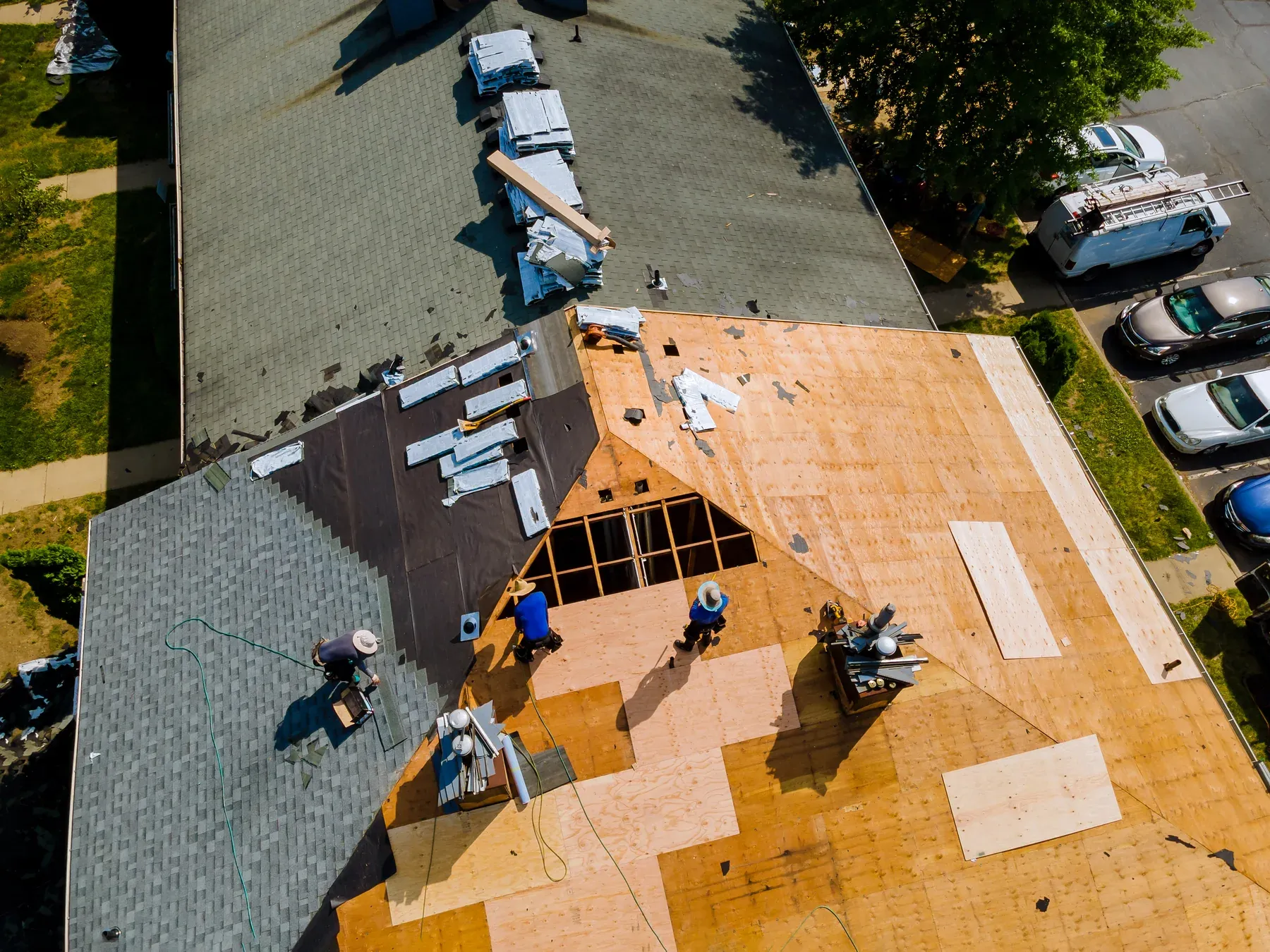 Illustrative photo: tear-off, decking, underlayment and shingle bundles during a reroof.
The layers under the shingles
Manufacturers describe a shingle roof as a system of parts that work together. Owens Corning's overview of its roofing system explains the roles in plain terms:
- Underlayment sits under the shingles as a water-shedding layer that helps against wind-driven rain.
- Ice and water barrier, sometimes called leak barrier, protects spots where water tends to collect or run, such as valleys, eaves, chimneys, and skylights.
- Starter shingles run along the eaves and rakes so the first course has a straight edge and a good seal in areas exposed to strong wind.
- Hip and ridge shingles cap the peaks, which also take the brunt of high winds.
You will often see drip edge too, the metal trim along the eaves and rakes. Ask where each product goes. "Leak barrier in valleys" and "leak barrier at all valleys and eaves" are different scopes, even though both lines use the same words.
Flashing, ventilation, and the details that leak
Flashing is the metal that seals transitions: walls, chimneys, skylights, valleys, and pipe penetrations. A clear estimate says whether existing flashing will be reused or replaced, and which pieces. Pipe boots and vent covers are small line items, but leaving them out of the scope can cause trouble later.
Ventilation should appear as specific items with quantities, such as ridge vent, box vents, or soffit intake. The same Owens Corning overview describes intake and exhaust ventilation as working together to manage attic heat and moisture. If one bid adds ridge vent and another keeps the existing vents, ask each contractor why. Our article on attic ventilation and shingle life explains why this line deserves a conversation in Houston heat.
Permits, cleanup, and the fine print
IBHS advises that where a local government requires a reroofing permit, the roofer should secure it before work begins (IBHS homeowner guide), and the FTC lists a contractor asking you to pull permits yourself as a warning sign. Check that the estimate says who handles the permit and whether the fee is included.
Also look for:
- Cleanup, including a magnetic sweep for nails
- Protection for landscaping, gutters, and items in the attic
- How change orders are priced; the Texas Attorney General notes that contractors often charge to change the work order and that the contract should address it
- Expected start and completion, and how weather delays are handled
- Warranty terms, spelled out; see manufacturer vs. workmanship warranties
Comparing two estimates fairly
Put the bids side by side in a simple table with one row per item: tear-off layers, decking allowance, underlayment, leak barrier locations, drip edge, starter, shingle product, ridge cap, flashing, ventilation, permit, cleanup, and warranty. Mark each cell included, excluded, or unclear.
The Attorney General recommends written bids from more than one contractor and caution about a price far below the rest, since a very low bid may leave out tasks you would expect. Your unclear cells become your question list, and a solid contractor should answer them in writing.
If insurance is involved, compare the contractor's scope with the insurer's estimate item by item; our guide to insurance funding gaps shows how. For budgeting, see Houston roof replacement financing, and for what happens after you sign, read the replacement process and timeline.
Holding an estimate with a few lines you cannot decode? Call (210) 756-2374 to book a free roof check with WorkHorse Roofing, and ask us to walk through any line in our written scope. No mystery. No runaround.
Sources & further reading
WorkHorse field notes
Straight answers. Clear next steps. Built for Texas homeowners.